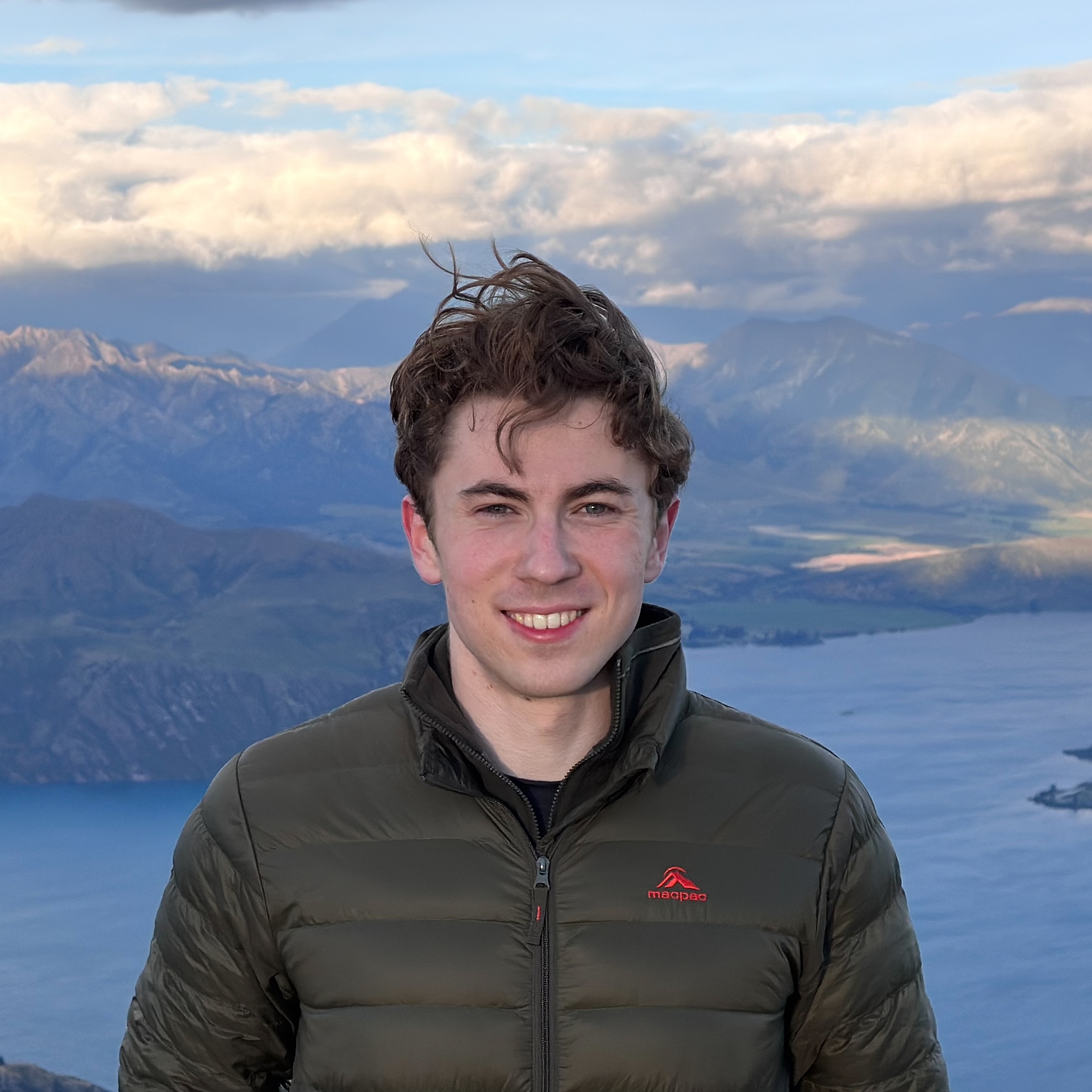
About me
I am a PhD student at the University College London Physics and Astronomy Centre for Doctoral Training (CDT) in Data Intensive Science. I am part of the SciAI Group at Mullard Space Science Laboratory, and I am supervised by Professor Jason McEwen. My research focuses on high-dimensional Bayesian evidence computation with nested sampling, and self-supervised uncertainty quantification for inverse imaging problems. My research is motivated by problems in cosmology, though the methods I develop are general frameworks with broad applicability.
I have recently completed a 6-month industry placement as a Machine Learning Researcher at RevEng.AI as part of my CDT. At RevEng, I led the development of uncertainty quantification for LLM-based binary decompilers using conformal prediction. I completed a CDT industry group project in the first year of my PhD at MediaTek Research UK where we developed a neural network compression technique that utilised second-order information.
Prior to my PhD, I completed an MPhys in Physics at the University of Leeds. My Master’s project developed a CNN pipeline for classifying images of cancerous cells, supervised by Professor Stephen Evans.
Projects
High-dimensional Bayesian evidence computation
The Bayesian evidence is the probability of observed data given some model. It is therefore a useful quantity for performing model comparison and evaluating which model is a best fit. As it is the denominator of Bayes’ theorem, it can be expressed as an integral, marginalising over all parameters. However, this means at very high dimensions it is extremely hard to compute. Nested Sampling[1] provides a clever way to shift the computational difficulty of summing over all parameters in our integral to our ability to generate samples from our prior that are constrained by their likelihood. This alleviates a substantial amount of computational difficulty, but Bayesian evidence computation remains difficult nonetheless.
Current research into Bayesian evidence computation often involves developing more efficient methods to generate these likelihood-constrained samples from the prior, which is where my work fits in. My research involves a novel Langevin Markov chain Monte Carlo sampling approach, which pushes Bayesian evidence computation to higher dimensions. Applications include inverse imaging problems, where the Bayesian evidence can be computed and compared between various reconstruction models, including data-driven priors such as denoising neural networks, to identify which image reconstruction is the most plausible in the absence of ground truth. Bayesian evidence is additionally widely used in cosmology and other astrophysical domains where we have a number of models describing the physics of the Universe and we want to know which is best supported by the data.
Self-supervised image uncertainty quantification
Inverse imaging problems are frequently ill-posed, leading to many plausible image reconstructions, and thus a large degree of uncertainty. In domains such as the physical and medical sciences, quantifying uncertainty in image reconstructions is crucial for downstream analysis. Image uncertainty quantification methods tend to be heuristic, without any rigorous coverage guarantees, leading to untrustworthy uncertainties. Conformal prediction[2] provides a means to calibrate heuristic uncertainties, providing strong statistical guarantees. However, conformal prediction relies upon a set of ground truth calibration data. Such data may not be easily accessible, or may rely upon simulated data that is dependent on underlying assumptions or parameters that may not be representative of the truth, as is the case in dark matter mass-mapping. My research explores the possibility of image uncertainty quantification methods that have been calibrated with conformal prediction in a self-supervised manner, alleviating the requirement of ground truth data.